
Searching for a Warrant in Litchfield County
Litchfield County has no sheriff warrant division. County sheriffs ended in 2000, so criminal warrants move through state court and police systems. Start with the Judicial Branch Criminal and Motor Vehicle Case Look-up. Treat it as a convenience display, not the official record. Confirm any lead with the clerk. Before you search, gather the legal name, date of birth, an approximate date, the town, the court or police agency, and a docket if you have one. Then follow this sequence:
- Identify the likely Superior Court location from the town and paperwork.
- Search by name or exact docket route available on the live form.
- Compare the person, court, case type, and dates.
- Call the assigned clerk to ask whether warrant or rearrest process remains outstanding.
- If directed, contact police about surrender or the custodian about a focused record request.
Litchfield County Has No Sheriff Search
The county-sheriff model simply does not fit Litchfield County. Local police and Connecticut State Police execute criminal process, while judicial marshals handle courthouse security and custody. State marshals serve civil and qualifying capias process, including some family-support matters. None of them keeps a county criminal-warrant roster.
Key point: A blank web search is not a status check. The issuing Superior Court clerk is the confirmation source.
For the Torrington-area route, call the GA 18 criminal and motor-vehicle clerk at 860-626-2300. The Litchfield Judicial District public-information line is 860-626-2100. Both sit at 50 Field Street, Torrington, so ask which clerk owns the case before discussing process.
Warrant Search Fields Explained
The Judicial Branch interface can change, and some controls render dynamically. Its official inventory supports the fields below, though required markers and button labels must be read live. No public field in Litchfield County promises a complete active-warrant result.
| Field label | Type | Required | Use |
|---|---|---|---|
| Last name | Text | Verify live | Primary case lead |
| First name | Text | Narrowing where shown | Reduces common-name matches |
| Date of birth | Date or text | Verify live | Distinguishes identities |
| Docket number | Text | Alternative route | Targets an exact case |
| Search, clear, help | Controls | Labels vary | Runs or explains lookup |
Never send a Social Security number, an unrelated address, or family details through an unverified form. Even with permission, sealed and juvenile limits still apply in Litchfield County.
Read a Litchfield County Docket
A Connecticut docket number ties a result to its court context. Judicial materials describe the parts: court location, case type, a two-digit year, a seven-digit sequence, and a suffix. CR can mark a criminal file. MV marks a motor-vehicle file. Use the number from official Litchfield County paperwork, never a guessed value.
- GA
- Geographical Area of Superior Court.
- JD
- Judicial District of Superior Court.
- FTA
- Failure to appear, which may cause bench or rearrest process.
- PRAWN
- The restricted Paperless Arrest Warrant Network.
Location matters because county borders do not control every assignment in Litchfield County. Watertown may route to GA 4 in Waterbury, while Plymouth may route to GA 15 in New Britain.
What a Warrant Search Shows
A public case display may show a docket, a party match, a charge, the court location, events, pending status, or limited disposition. It can prompt a clerk call. What it may not tell you is whether a Litchfield County warrant is active right now.
| Docket number | A court/type/year/sequence/suffix identifier, represented as LOCATION-TYPE-YEAR-SEQUENCE-SUFFIX. |
|---|---|
| Defendant match | Name and limited identifiers used to avoid a common-name mistake. |
| Charge or case | The alleged matter, not proof of guilt. |
| Issuing court | The Superior Court location whose clerk verifies the file. |
| Process and status | Any bench, rearrest, service, recall, or disposition label needs confirmation. |
| Release information | Bond or conditions vary by order and cannot be inferred from a charge. |
A warrant record can also involve an affidavit, order, return, arrest record, mittimus, or release order. Access rules differ for each item in Litchfield County files.
Why a Blank Litchfield County Result Misleads
A blank Litchfield County result proves little. It may reflect spelling, the wrong court, a new matter, sealing, or protected status. The display can also omit a warrant field, and a shown event may have changed since the last update. Either way, nothing is settled. The official disclaimer states the lookup is not the official record and is not guaranteed complete, current, or error-free. Confirm with GA 18, Litchfield JD, or the assigned court. Police may hold newer internal information because PRAWN serves authorized justice and law-enforcement users.
Note: PRAWN has no public fields, public results, or lawful self-service login for a Litchfield County warrant lookup.
The official PRAWN program page shows the system behind authorized warrant work.
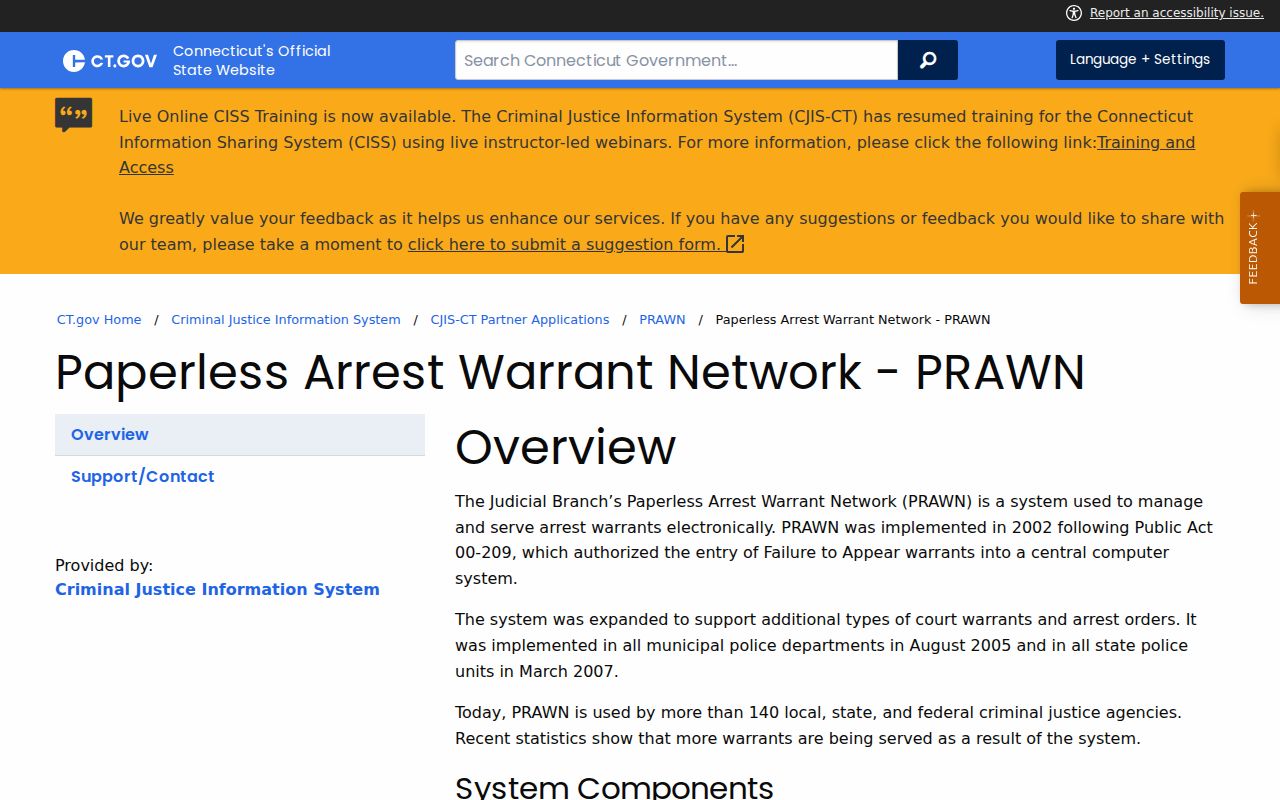
The captured source reinforces why PRAWN is protected infrastructure, not a public search box.
Where to Check Warrants in Litchfield County
Each channel answers a different question. In Litchfield County, use court sources for process and case records, police for execution directions, and the custodian for inspection or copies. OPM publishes aggregate data, not names.
| Channel | What it does | Limit |
|---|---|---|
| Judicial lookup | Finds a public case lead | Not official confirmation |
| GA 18 or JD clerk | Confirms assignment and process | No legal advice |
| Local or State Police | Gives execution or surrender directions | Cannot recall a court order |
| OPM reports | Shows monthly categories and counts | No person search |
| FOIA request | Seeks an existing public record | Exemptions apply |
Bail / Pretrial Services at 860-626-2160 answers release-process questions once the court route is known. It is not a search line. The state documents its connected Criminal Motor Vehicle System, which serves justice agencies rather than Litchfield County callers.
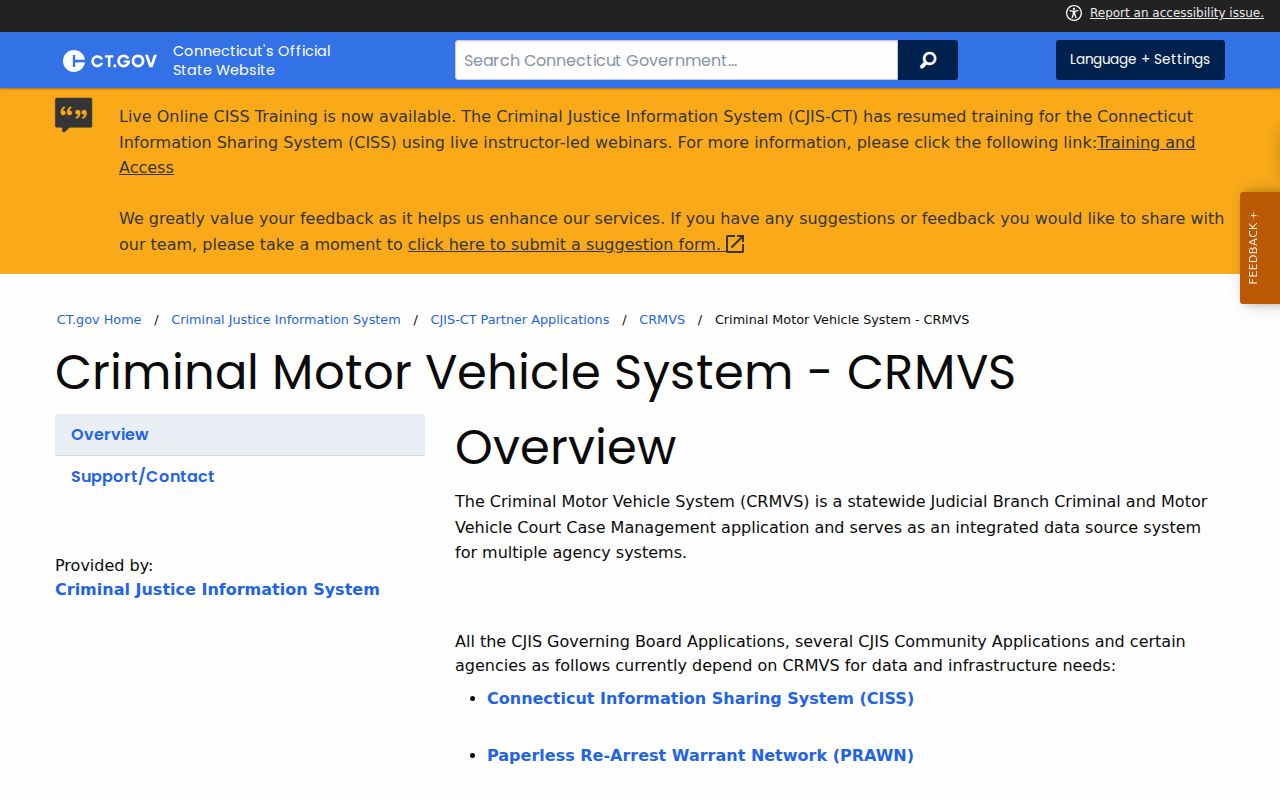
This official view separates agency data exchange from the limited public case-search experience.
From Litchfield County Lead to Confirmation
When a match appears, note the docket, the court, the case type, the dates, and the exact label. Call the clerk through an independently verified Judicial Branch number. Ask whether process is active, which court issued it, what identity proof is needed, whether counsel may arrange a walk-through, and where release questions belong. If surrender is required, ask for the location, current hours, photo ID, security steps, and whether police must be called first. No Litchfield County office publishes counter hours, bond-window methods, or a same-day promise, so get those details on the call. Counsel can ask about recall or quash procedure, and only the court can withdraw process. The county warrant records overview describes the broader resolution path.
Restricted Litchfield County Warrants
Connecticut FOIA supports access to public agency records, but not every Litchfield County warrant document is open. CGS §1-215 covers qualifying arrest records and applications or affidavits while preserving exceptions. CGS §46b-124 protects juvenile police and court records. Sealing, active investigations, privacy rules, and other laws can each limit access.
Access limit: Never treat a missing juvenile, sealed, protected, or newly issued record as proof that no warrant exists.
For an existing record not online, send a focused request to its custodian. The FOI request guidance says no universal form is required. Identify the agency, the docket or range, the record type, and the format. The FOIC complaint route is an appeal, not a Litchfield County warrant lookup.
Litchfield County Request Boundaries
In Litchfield County, records live in separate hands. Court files sit with the Judicial Branch, and police files with whichever department or State Police unit holds them. State-marshal matters go through the marshal or the Commission. So one blanket request to a county office goes nowhere, because no consolidated custodian exists. Ask for a document that already exists: a policy, a log, or a count with no names attached. Skip the idea of a freshly compiled warrant name list; nobody builds one on request. Fees are capped under Connecticut law, generally 25 cents per page for state records and 50 cents per page for municipal ones, though format and current statutes can shift the total. No Litchfield County office posts a fee for status confirmation, certified copies, or a special clerk search, so ask for a quote before you order anything.
Note: A records request may obtain documents, but it cannot replace direct clerk confirmation of current Litchfield County warrant status.